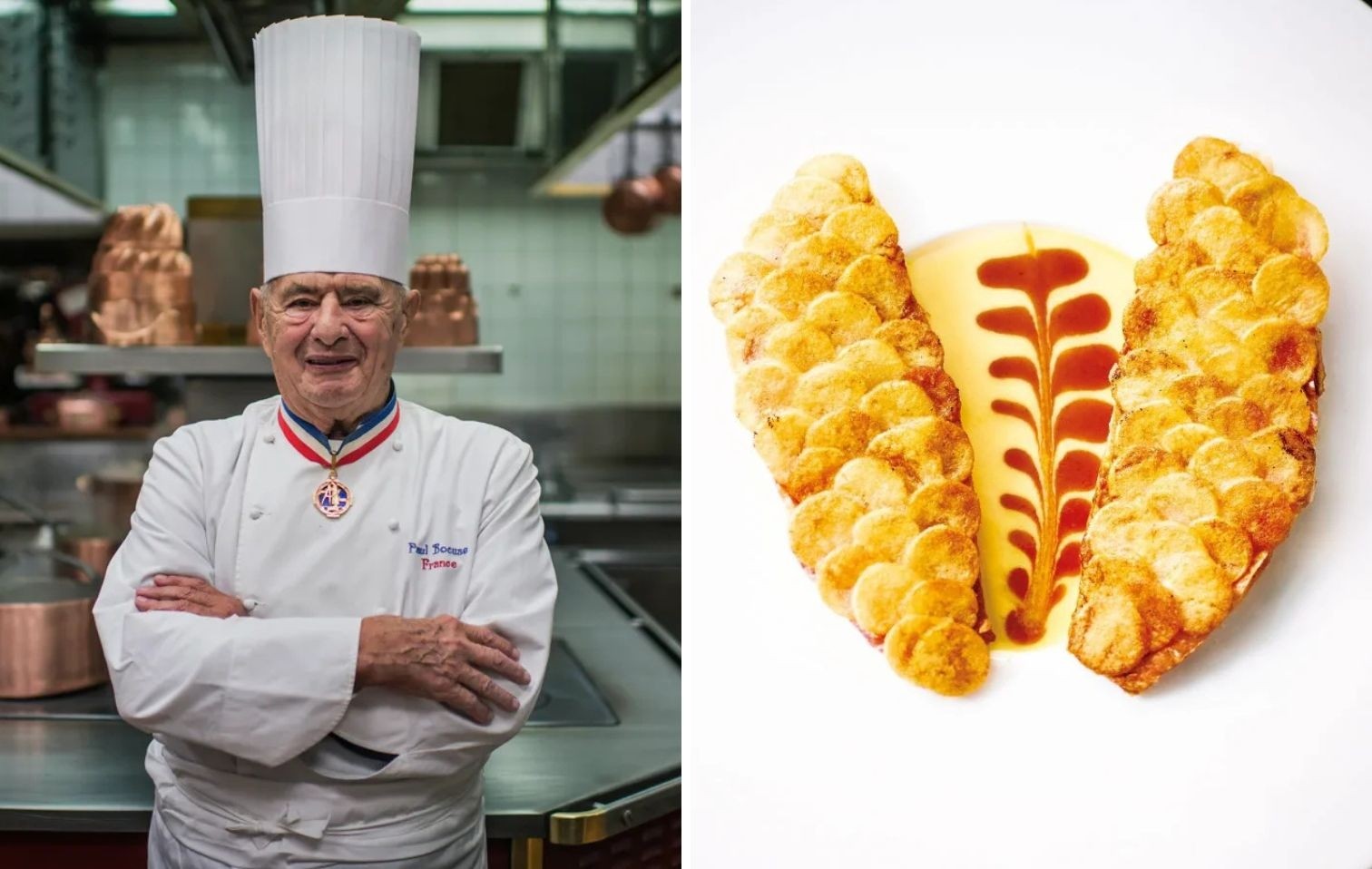
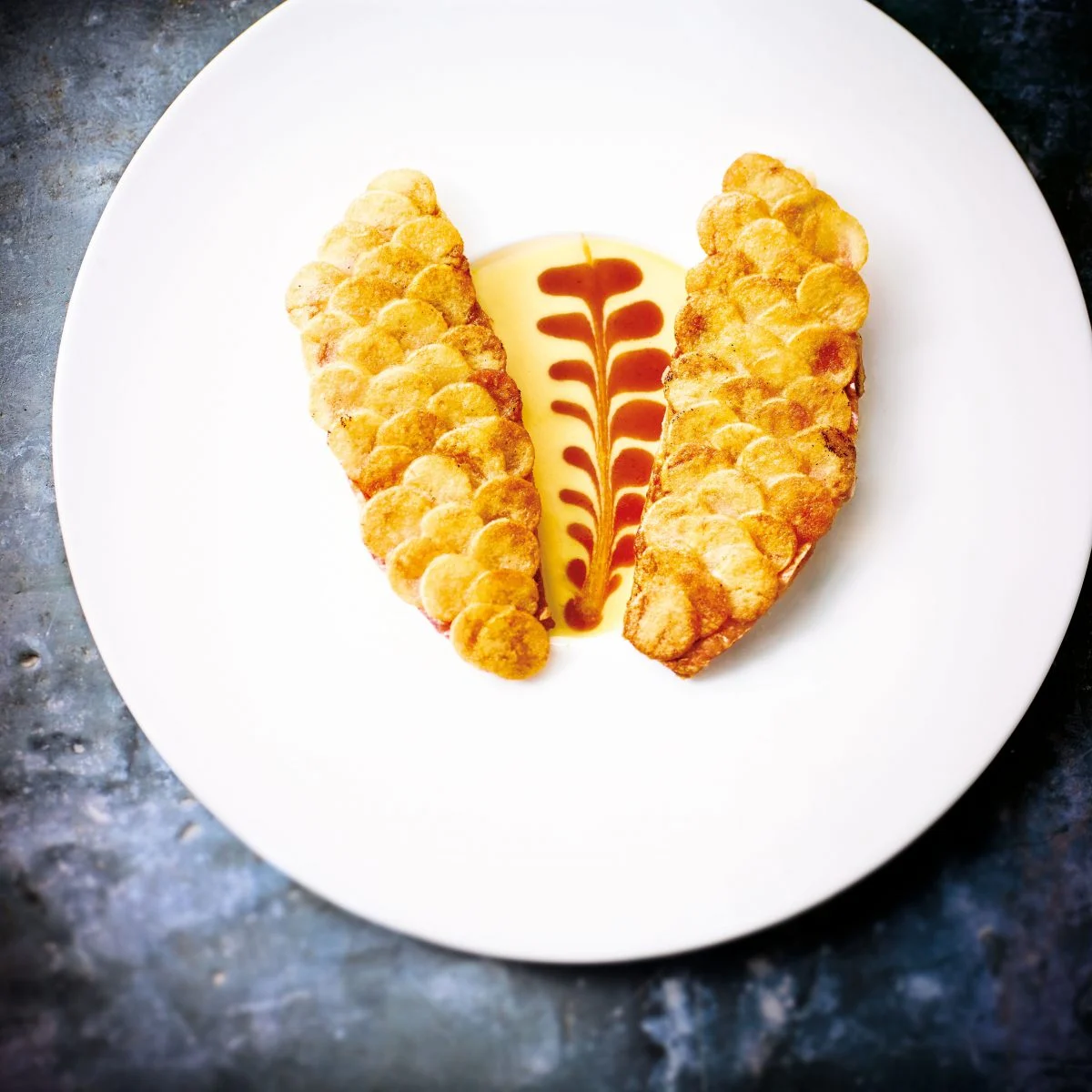
The dish’s uniqueness lies entirely in an ingenious “reversal of meaning”: recreating the fish’s skin and scales using a golden vegetable “armor”
Photo of Valery Guedes’s dish
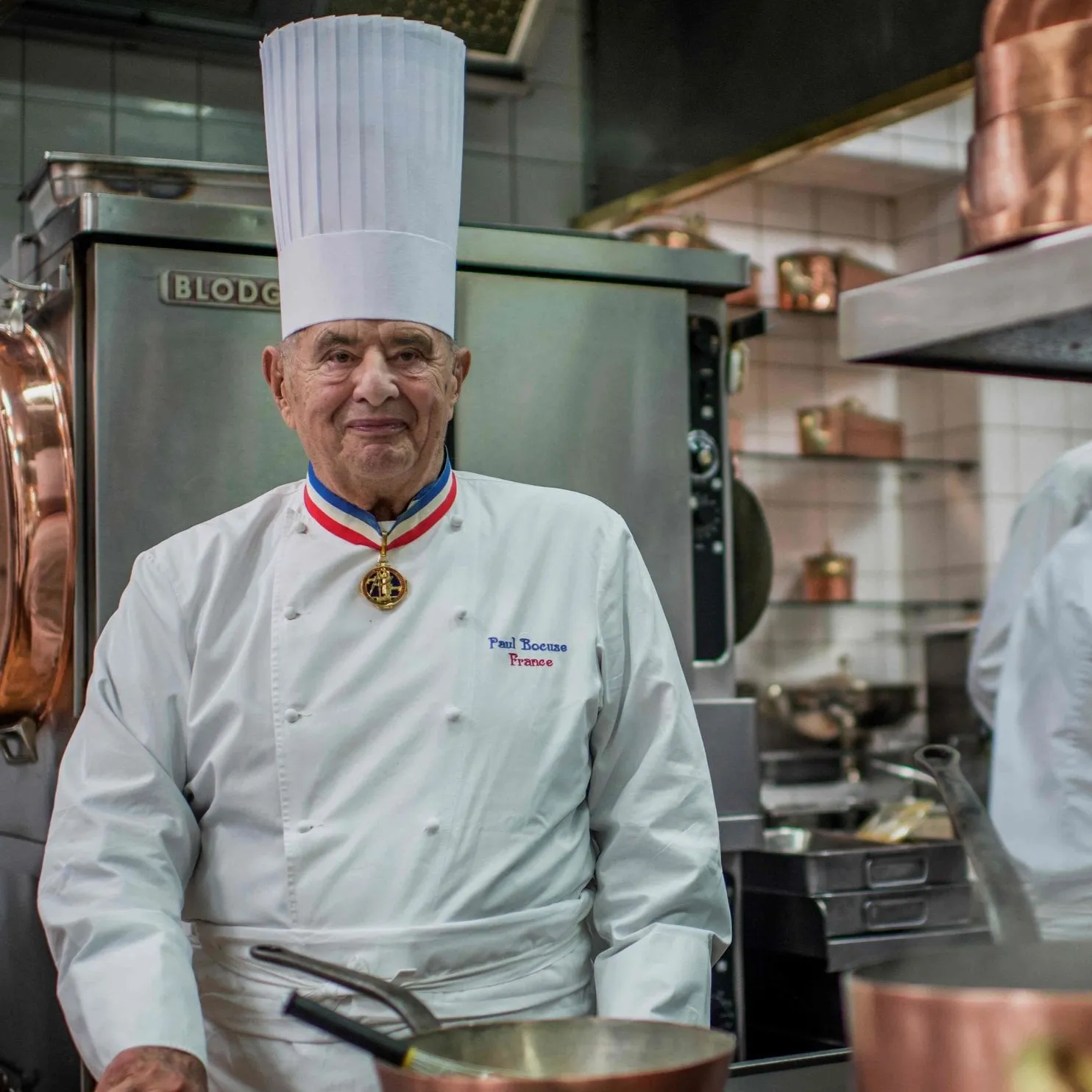
If there is one image capable of representing the timelessness of Lyon’s haute cuisine, it is that of a seemingly simple dish that creates a “three-dimensional” taste experience on the palate. In this sense, Paul Bocuse was not only the patriarch of Nouvelle Cuisine, but—first and foremost—a master in the art of taming ingredients without stripping them of their essence. The great chef’s free-spirited style—often wrongly portrayed as overly solemn—was in fact based on a very clear triad: clarity of flavor, legibility of presentation, and precision in cooking. No abstract frills, no alchemist’s pretensions, but a concreteness that ultimately knew how to become visual poetry.
The Dish
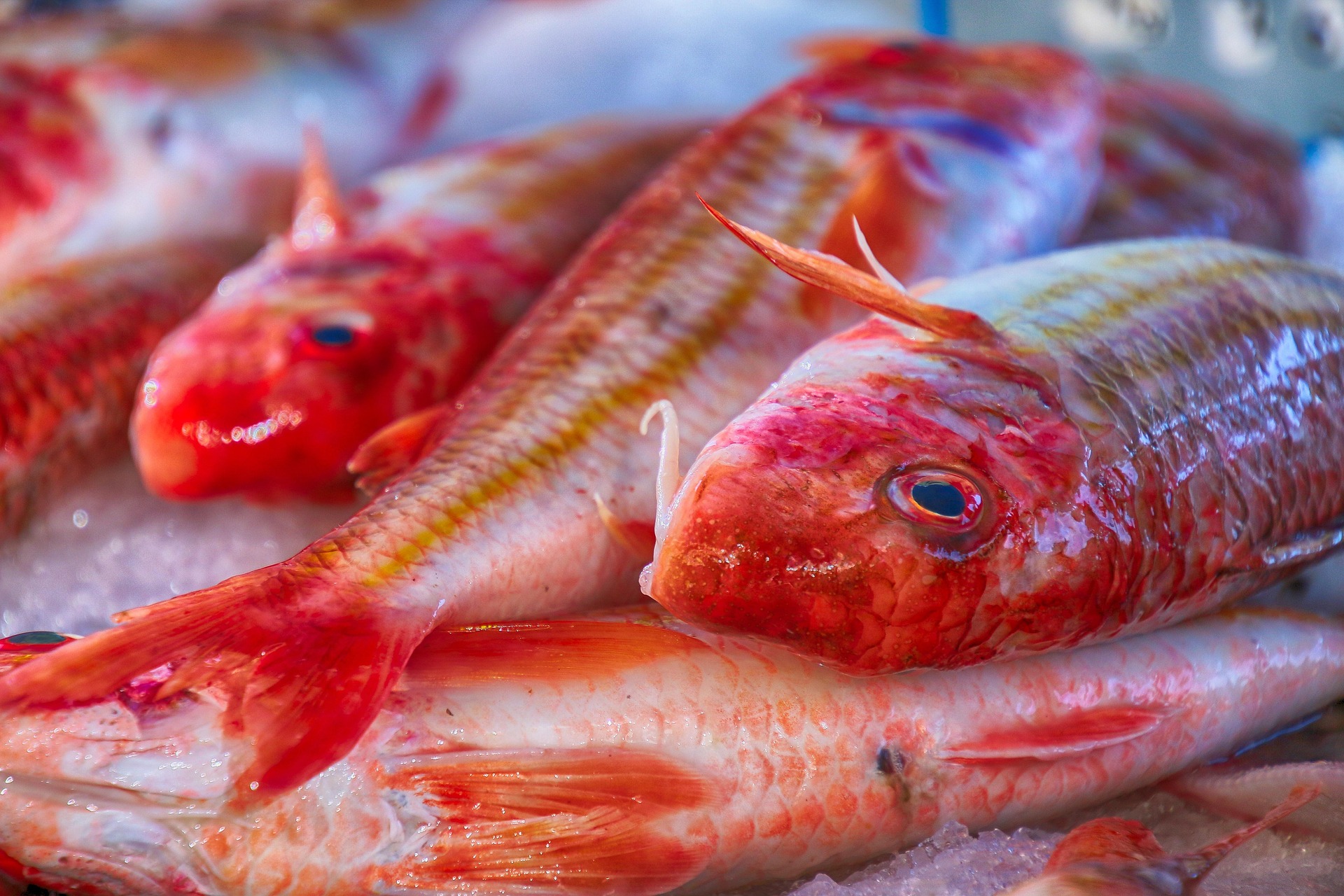
Among Bocuse’s historic creations—from the famous V.G.E. truffle soup protected by its puff pastry dome to the Bresse chicken in a bladder—the red mullet with potato shavings is perhaps the most fitting example of this sort of optical illusion: a duality between aesthetic purity and the metamorphosis of flavors. The dish’s uniqueness lies entirely in an ingenious “reversal of meaning”: recreating the fish’s skin and scales through a golden vegetable armor. Thus, the tuber does not serve as a side dish; rather, it is the protective shell that retains the juices of the fillet and ensures the right contrast between the soft, briny flavor of the red mullet and the toasty aroma of the vegetable.
To balance the richness of the clarified butter and the starchy sweetness of the potatoes, a bold sauce made with orange, rosemary, and Noilly Prat comes into play: a reduction where the citrus note and balsamic undertone cleanse the palate. No sooner said than done: thanks to Bocuse, the red mullet becomes a symphony of bitterness, acidity, and lingering umami.
The Recipe: Red Mullet Fillets with Potato Shavings
Serves: 4 people
Prep time: 50 minutes
Resting time: 15 minutes
Cooking time: 10 minutes
Ingredients
For the red mullet and potato crust:
- Red mullet fillets: 2 large fillets (from fish weighing about 350 g each)
- Potatoes (Bintje variety or firm yellow-fleshed): 2 large
- Egg yolk: 1
- Clarified butter: 2 tablespoons
- Potato starch: 1 teaspoon
- Veal stock (optional): 2 tablespoons (for finishing)
- Chervil: 1 fresh sprig
- Olive oil: 2 tablespoons
- Fine salt: to taste
- Water: 1 teaspoon (for emulsifying the egg yolk)
For the orange and rosemary sauce:
- Oranges: 2 (juice)
- Fresh rosemary: 3 sprigs
- Noilly Prat (or dry vermouth): 10 cl
- Fresh liquid cream: 300 g
- Fine salt: to taste
- Freshly ground black pepper: to taste
Method
1. Preparing the red mullet and potato “ruler”
Cleaning the fish: Carefully remove all bones from the red mullet fillets using kitchen tweezers.
Support base: Cut two rectangles of parchment paper slightly larger than the fillets. Place the fillets on top with the skin facing up.
Egg Yolk Glue: In a small bowl, beat the egg yolk with a teaspoon of water and a pinch of fine salt. Brush the mixture evenly over the entire surface of the fillets’ skin.
2. Shaping the Potato Scales
Slicing into rounds: Peel the potatoes, wash them, and slice them into very thin rounds (ideally with a mandoline).
Cutting the flakes: Using a melon baller (or a small round pastry cutter), cut out small discs from the potato slices to mimic fish scales.
Quick blanching: Place the trimmings and potato discs in a pot, cover with cold water, bring to a boil, and let boil for exactly 1 minute. Drain immediately.
Seasoning and Arranging: Place the potato “scales” in a bowl with 2 tablespoons of clarified butter and toss to coat. Add the teaspoon of potato starch and mix well.
Assembly: Arrange the potato scales over the skin of the fillets, starting from the head and overlapping them slightly toward the tail, just like real fish scales.
Resting: Transfer the prepared fillets to the refrigerator for 15 minutes: as the clarified butter cools, it will solidify the flakes, causing them to adhere perfectly to the fish flesh.
3. Preparing the Sauce
First Reduction (Citrus and Rosemary): Squeeze the oranges. Pour the strained juice into a small saucepan along with the fresh rosemary sprigs. Place over medium heat and let it reduce until the liquid has almost completely evaporated.
Second Reduction (Vermouth): Pour the Noilly Prat into the saucepan and reduce it by half.
Thickening with Cream: Stir in the fresh liquid cream, a generous pinch of salt, and freshly ground black pepper. Let it reduce over high heat for about 10 minutes, stirring occasionally, until it reaches a smooth, velvety consistency.
Finishing: Strain the sauce through a fine-mesh strainer to remove the rosemary and keep it warm.
4. Cooking the Fillets
Heat 2 tablespoons of olive oil in a large nonstick skillet.
Lift the fillets directly from the rectangles of parchment paper and gently flip them into the skillet, potato side down. Carefully remove any remaining parchment paper from the surface.
Season the flesh of the fish (which is now facing up) with salt.
Cook over high heat for about 6 minutes, until the potato flakes are evenly golden and crispy (the exact time depends on the thickness of the potatoes).
Using a spatula, flip the fillets to the flesh side and finish cooking for just a few seconds.
5. Plating
Coat the bottom of each individual plate with a generous layer of warm orange sauce.
If desired, drizzle a few drops of reduced veal stock over the sauce to create a decorative pattern or a pop of color.
Gently place the red mullet fillet in the center of the plate with the golden flakes facing upward.
Garnish with a few fresh chervil leaves and serve immediately while still very hot.