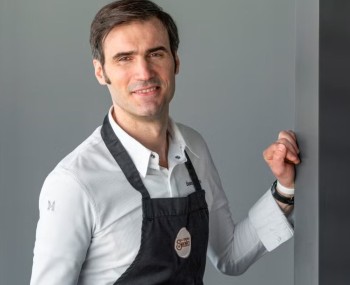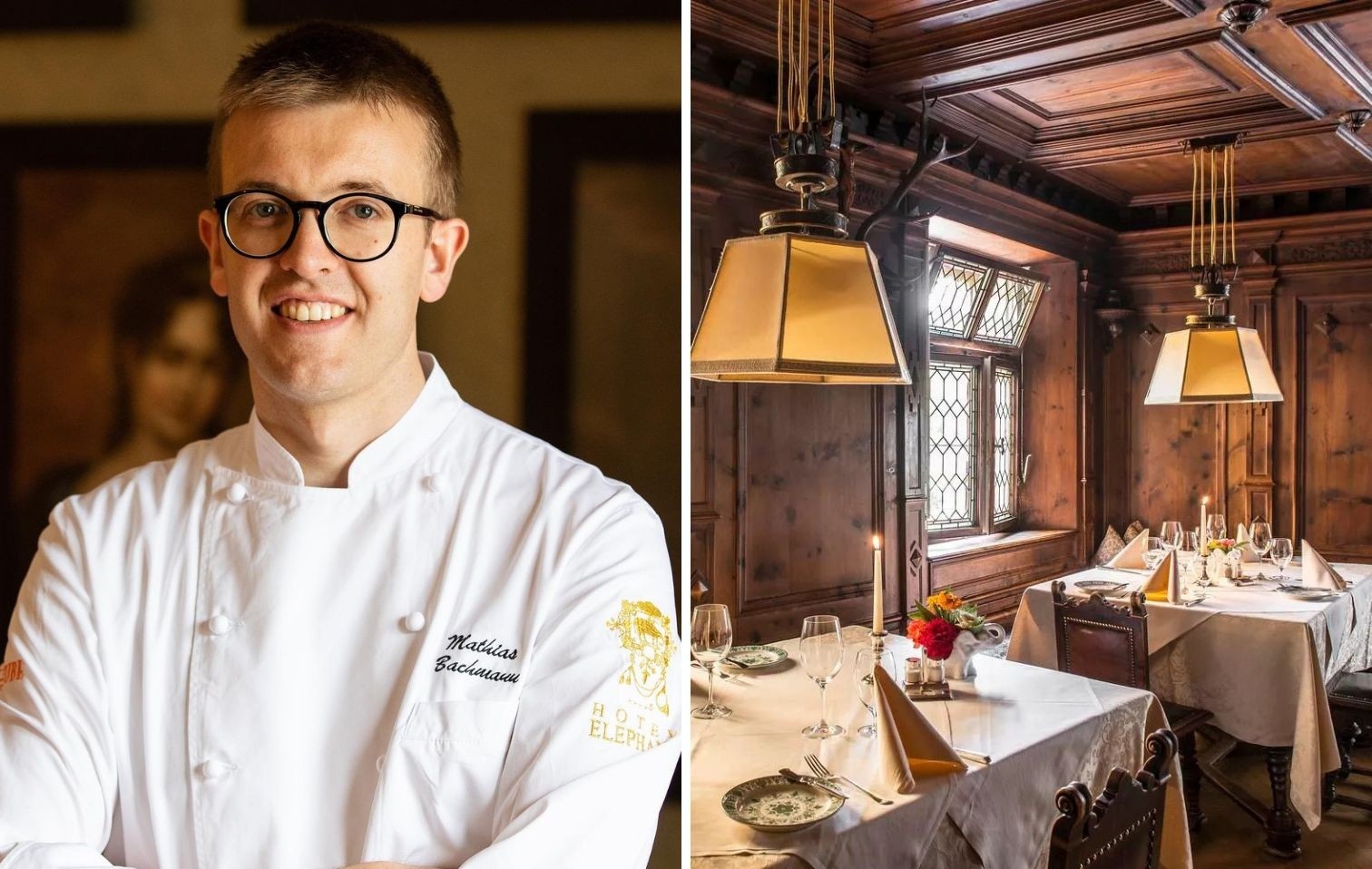
The local “enjoyable compasses” guide newcomers to the hotel's traditional restaurant, but the Elephant also houses a Michelin-starred gourmet restaurant, an underground spa, and a 2-hectare “green labyrinth.” Mathias Bachmann is responsible for creating this gastronomic haven, choosing a dual approach to convey the purity of the ingredients.
The hotel
L'Elephant carries 500 years of history on its back, perfectly divided between the allure of Tyrolean wooden stube and the charm of “period film” corridors. Yet, that half-millennium recorded in the registry has not diminished its holiday hype one bit: if you walk through a sign with the same family management since 1773, you would expect to find at least a few small signs of wear and tear, but here the first thing you notice is the dynamism - a wealth of hereditary hospitality that travels swiftly from the bar & lounge, inspired by the old literary cafés, to the Michelin-starred restaurant run by chef Matthias Bachmann.


Thus, the baby elephant chosen as the hotel's mascot (not coincidentally, the second oldest in Bressanone) becomes a symbol of a curious “stability in motion”—that sort of tightrope walking that allows the classic, dated structure to remain alive. In all this, the stylized animal logo is not a graphic designer's whim, but evidence of a decisive moment in the South Tyrolean town's history: during the long journey from India to Vienna in 1551, the pachyderm Soliman arrived in Bressanone and stayed for 14 days under the roof of the original owner Andrä Posch, leaving his mark on the future of hospitality and even inspiring the name of the complex.

And so, as the inhabitants poured into the streets to admire the giant exotic mammal, news of the care that the innkeeper devoted to him gradually increased the Elephant's notoriety. Today, the 4-star legend continues under the management of the Heiss-Falk family, guardians since the late 18th century of a timeless hospitality that has never ceased to set the trend.

The “new classic” of the Elephant Restaurant
Speaking of trends, the “delightful compasses” of the place guide newcomers to the hotel's traditional restaurant, where the aim is to entertain as well as tempt the palate. Those who choose to dine in the Zirbelstube in cirmolo, surrounded by towering emerald-colored stoves, will immediately feel as if they have slipped into a convivial Alpine scene: at the entrance, your gaze lingers on the oak paneling crafted by local artisans, the warm lights, and the mountain flowers scattered everywhere, before catching the quick movements of the maître d' as he prepares a string of tartares (a staple appetizer on the menu thanks to the theatricality of the gesture, not to mention the pairing with salted butter and crispy baguette).

In our case, the revealing taste was, however, the deer carpaccio with marinated chanterelle mushrooms and aromatic herbs, in which the “green addition” stands out both for its visual geometry and expressive intensity, pleasantly shifting the focus to the botanicals present. The gastronomic nest was put together by Matthias Bachmann, executive of the entire structure with a firm hand on both the Elephant Restaurant and the gourmet Apostelstube (a macaron since 2019). It is precisely the consistency between the two establishments (one focused on nostalgic recipes, the other on a blend of memory and global insights) that ties together the various branches of the restaurant, as the focus always remains on the clarity of the ingredients, never suffocated by extreme technical flourishes.

This is demonstrated, again in the traditional stube, by the Schlutzer stuffed with spinach and ricotta, mountain cheese, and brown butter, a small rhyming couplet between the pasta and the filling: surprisingly, the rustic flavor of the spinach is behind the umami of the seasoning, holding its own against a topping of remarkable depth. Furthermore, the veal cheek braised in a wooden barrel with whisky rests peacefully on a bed of Storo polenta; it could be the usual ‘malga style’ main course, but instead it benefits from the earthy presence of shiitake mushrooms and a lively marjoram jus. No less daring is the strudel crust, which is very different (a plus in our opinion) from the orthodox “veil-effect” pastry used by some local bakeries. The tension on the surface prepares the jaw for the spontaneous embrace of the fruit, leaving room for the last bite of dessert.


Apostelstube: the star-studded sign
As for the Apostelstube, it would be easy to talk about exclusivity, since there are only four tables available and (inevitably) they are often sold out. Nothing could be further from the truth, given the pleasant sense of intimacy that pervades this “secret room” with its undergrowth-inspired look: in the center, the modernist symmetry of 1920s Art Deco; on the sides, the color spectrum of a forest at dusk.

A forest that feeds a substantial part of Bachmann's pantry, absorbing like a sponge the mixture of cultures that the young chef blends into the menu. Whichever path you choose, a close-knit trio makes its debut in the stube: French structure, Mediterranean sensibility, and Japanese rigor, destined to form a tacit pact on the plate. There are two options: Soliman's journey in the Elephant Park, which exactly follows the stages of the 16th-century journey (from Mumbai with purple curry, lobster, and lettuce to Bressanone with essence of porcini mushrooms, roots, and lovage) and In the Apostelstube, where char splashes into the future with a light whey, Wagyu A5 is revealed to be local, accompanied by a black apple and Jerusalem artichoke jus, and the epilogue is entrusted to a fresh peach and myoga sorbet alongside orange blossom. But that's not all: the little elephant reappears in the depths of the cellar, named Soliman Wines; a Wunderkammer of 900 labels that we will tell you about shortly in a special feature on the Apostelstube.


The rooms
Come to think of it, the first thing that catches your attention after checking in is the exciting walk through the corridors, waiting to see the room for yourself. At the Elephant, those few minutes become a treasure hunt hidden along the timeline, as each corridor reveals sitting areas, retro furniture, walls dotted with paintings, and stained glass windows.


Entering the room or suite (today, there are a total of 43, 13 of which were recently created as part of the roof makeover) prolongs the initial sensation, with its chic armchairs and headboards embroidered with floral decorations. Spoiler alert: while in the Deluxe Double you can enjoy the luxury of a charming panoramic terrace, the largest suite boasts 50 square meters, further emphasized by marble and herringbone parquet flooring.


Relaxation even outside the suite: the café, the spa, the gardens
Between lunch and dinner, an espresso break (or a drink!) is the perfect excuse to spend a few hours in the lounge, with tables lined up in a row at the ends of the room and a long carpet that draws the eye towards the floor-to-ceiling windows. If you have ever wanted to experience the lively atmosphere of vintage coffee shops, this is the ideal place to imagine such places, with hot chocolate covered with a snowfall of foamy cream, South Tyrolean sparkling wine, and speck snacks prepared live. At the other end of the spectrum, detox enthusiasts gather in the underground spa, set up inside the 1888 stables.


Here, the original vaulted ceilings double as the surface of a large heated swimming pool, which is complemented by a Finnish sauna and steam bath. While the gym is perfect for athletes on the road, it would be a shame not to take advantage of sunny days to discover the Nordic flora of the park, which covers 2 hectares and is particularly impressive when the rose gardens are in bloom. As luck would have it, Villa Marzari, the hotel's annex, also offers a tennis court for outdoor training. But it's better on a full stomach, after a breakfast that showcases the region's sweet arsenal: with krapfen, strudel, and single-serving apple pie, your endorphins will be rising as soon as you wake up.

Contacts
Hotel Elephant
Via Rio Bianco 4- 39042 Bressanone, Alto Adige (Italia)
Phone. +39 0472 832 750