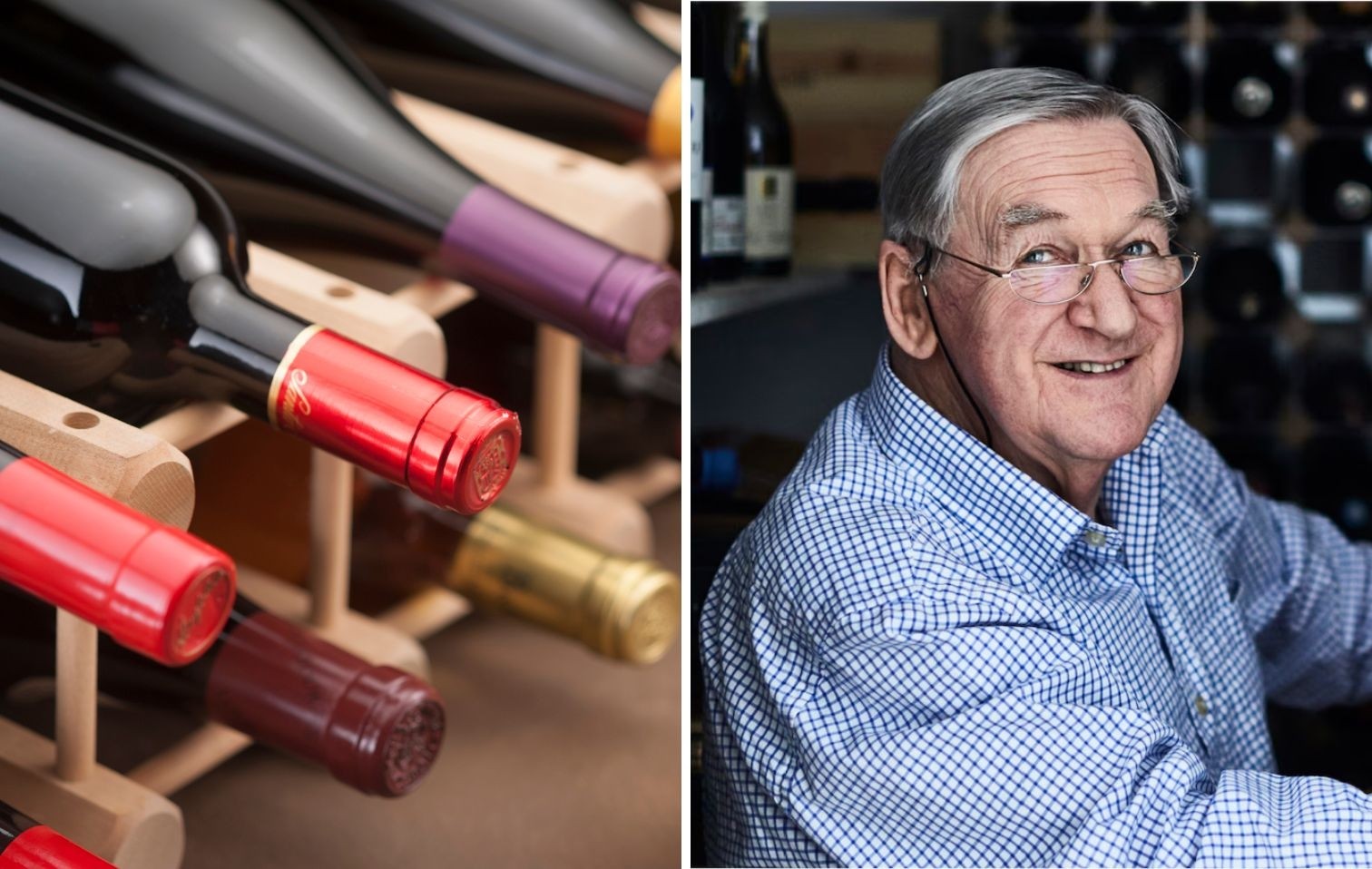
The great English critic and long-time voice of Decanter looks back on half a century of wine and shares his philosophy: no dictatorship of taste, wine should be shared and listened to, not reduced to a competition of scores.
Wine is never alone in a glass. It carries with it eras, economic crises, magazines born between scissors and glue, cultural disputes, and small intellectual rebellions. So says Hugh Johnson, the most elegant and ironic chronicler of the wine world, recalling the birth of Decanter in the summer of 1975.
In West London, at a time marked by the oil crisis and a less than sparkling England, a new idea was taking shape: a magazine for wine lovers who did not claim to be experts, colorful, accessible, capable of entertaining first and enlightening later. Johnson, with his light touch and sharp memory, reconstructs a time when wine was less spectacle and more mystery.
In his voice, you can hear the rustling of pages glued with Cow gum, the scent of printed paper that promised a different way of talking about bottles, vintages, vineyards, and tastings. Decanter, now celebrating its 50th anniversary, was born thus: more than a magazine, a cultural gesture.
Who is Hugh Johnson
Before becoming the most respected writer on wine, Hugh Johnson had already navigated complex publishing worlds. He took his first steps at Vogue, found himself replacing legendary editor Jocelyn Stevens at Queen, while at the same time cultivating his other great passion: gardening. The Royal Horticultural Society entrusted him with the task of transforming its century-old, stuffy Journal into a lively, readable publication capable of appealing to a wider audience. Johnson, therefore, was never just a wine critic: he was a weaver of languages, a bridge between the seriousness of the expert and the curiosity of the enthusiast.
How the world of wine has changed
In the 1970s, wine was still a territory full of naivety. Bordeaux produced just two memorable vintages, while Germany surprised with some brilliant bottles. Techniques were more rudimentary, and wines were often considered “good but needing time” because the acidity and tannins were not tamed as they are today. It was a world less saturated with information and capital, more naive and therefore more intimate.

One of the most vivid images evoked by Johnson concerns an almost surreal tasting: eight 19th-century vintages of Château d'Yquem, the king of Sauternes, opened at the same time. A feast for the palate, yet reduced to a competition: the 1847 was chosen as the best, while the others, each capable of illuminating an entire evening, ended up almost ignored. And here the critic's polemical streak emerges: wine should never be a competition, but an act of sharing. It doesn't matter who wins, what matters is discovering the nuances, celebrating what each bottle has to say, even in its imperfections.
“Among wine lovers, the goal should simply be appreciation,” writes Johnson, “sharing the qualities that each person enjoys in a wine... even overlooking the flaws.” It is a philosophy that still sounds like a lesson in elegance today: savor instead of measure, describe instead of classify.
Numbers and rankings
But the world of wine has not stood still. With the arrival of Robert Parker and his 100-point scoring system, even Decanter found itself “forced” to adopt numbers and rankings. Johnson never hid his impatience with what he called “the dictatorship of Baltimore taste.” His personal method was more instinctive, almost theatrical: he would line up the bottles and, depending on the tasting, push them forward or backward, drawing an immediate picture of his preferences. In Germany, he recalls with amusement, there were even those who decided the winner by measuring with a meter how much of the wine had been drunk. The emptiest label won. A questionable criterion, certainly, but irresistibly human.
This tension between classification and freedom, between the need to give a number and the pleasure of storytelling, remains at the heart of the modern wine debate. Johnson, with his irony, invites us not to forget the hedonistic side: “What's wrong with hedonism? Long live Decanter!”
Rereading Hugh Johnson's words today, one gets the impression that his vision remains highly relevant. At a time when wine risks becoming a status symbol, an object of speculation or “vault collecting,” his voice reminds us that the true greatness of a bottle lies in the simple gesture of raising it together with others. Wine does not need trophies: it just needs to tell a story, spark conversation, and make an encounter memorable.

And perhaps this is precisely the strength of Decanter, which in half a century has never ceased to be a storytelling laboratory, a space where expertise mixes with curiosity, where wines are not lined up for a medal but for a dialogue.
Fifty years on, Johnson's lesson is as clear as a crystal glass: rather than judging wine, it should be listened to. Not to determine which is the best, but to discover, with wonder, what makes each one unique.