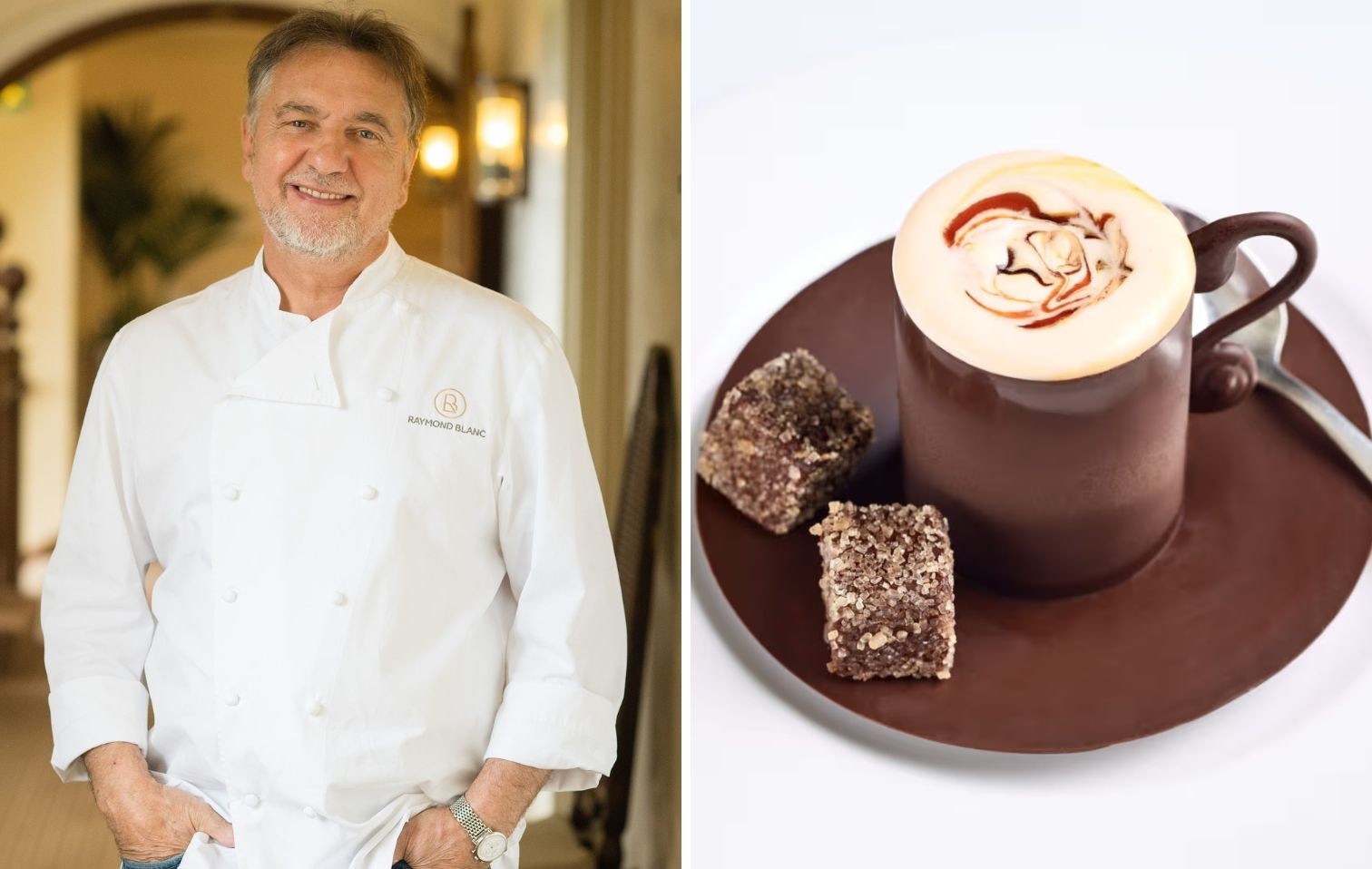
There are creations that are not simply the result of a recipe, but of extensive technical research. Blanc's Café Crème is the result of six months of absolute dedication, a period of gestation in which every detail was crafted to perfection.
The dessert
From calibrating the thickness of the chocolate to balancing the textures, every element was thoroughly tested until perfection was achieved. For the chef, therefore, bringing this dessert to the tables of Le Manoir aux Quat'Saisons was not just a debut, but a triumph of technique over uncertainty. “The beauty of this dish lies in the paradox: while for me it was the culmination of six months of concentration, for Monsieur Benoit and his team of pastry chefs it represents a daily challenge, an exercise in precision repeated thousands of times with the same, unchanging mastery,” writes the chef on the restaurant's website. Not only that: “When I showed it on the BBC's ”Kitchen Secrets“ program, the team had to make at least 100 of them a day!”
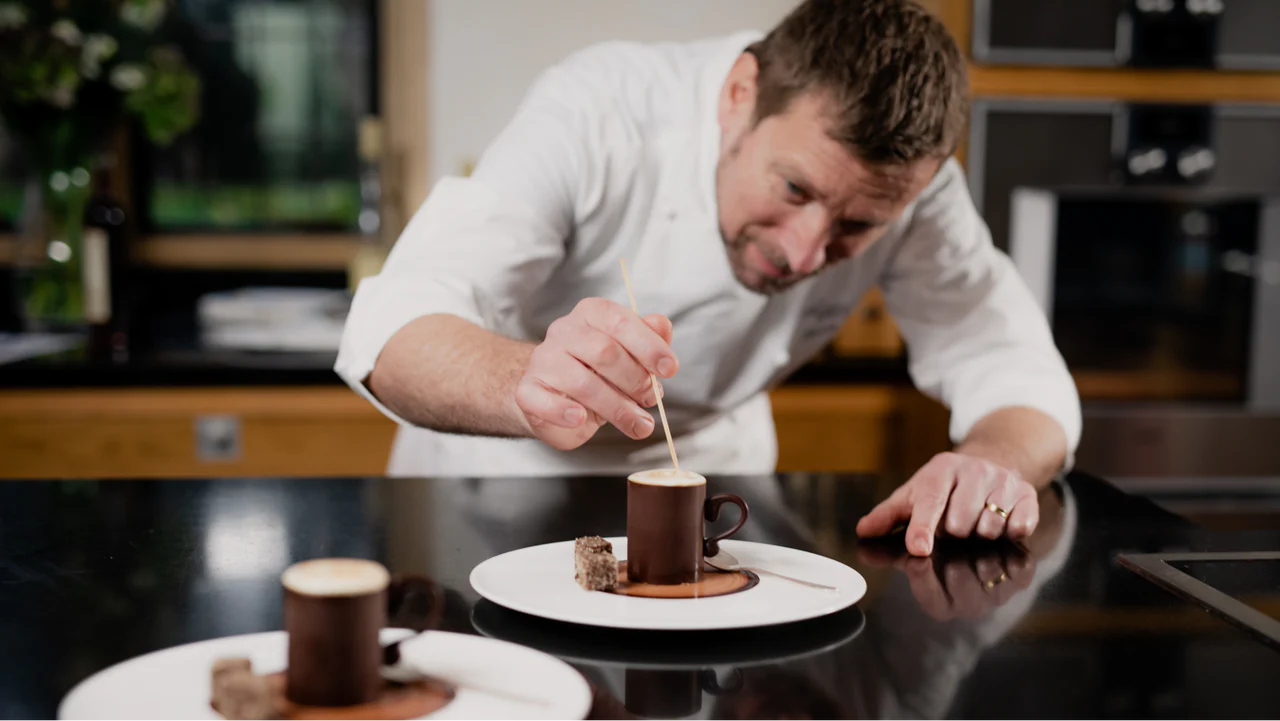
Despite its almost architectural complexity, which threatened to spark a “mini revolution” among pastry chefs, Café Crème reveals a precious secret: once you have mastered its technical pillars, it breaks down into a new alphabet of textures and flavors, redefining the grammar of gastronomy.
The recipe
Ingredients
For the chocolate cups, saucers, and handles
- 500 g Valrhona 65% dark chocolate, chopped
For the biscuit à la cuillère (sponge cake)
- 2 medium-sized organic or free-range eggs, whites separated from yolks
- 40 g caster sugar
- 40 g 00 flour
- 20 g icing sugar, for dusting
- 50 ml espresso coffee
For the coffee semifreddo and Kirsch zabaglione
- 150 ml whipping cream
- 100 ml water
- 120 g caster sugar
- 4 medium-sized organic or free-range eggs
- 1 teaspoon coffee extract or 50 g very strong black coffee
- 10 ml Kirsch
For the sugar cube ganache
- 100 ml whipping cream
- 100 g dark chocolate 65%, Valrhona, chopped
- 50 g Demerara sugar (to coat the ganache cubes)
To finish the dessert
- 20 g caramel or coffee extract
Method
1. Temper the chocolate
- Melt two-thirds (340 g) of the chopped chocolate in a double boiler in a metal bowl until it reaches 53°C.
- Remove from the heat and add the remaining third of the chocolate.
- Stir to cool quickly until it reaches 32°C (crystallization point).
- Keep the chocolate at 32°C during use, reheating it slightly from time to time.
2. Prepare the chocolate saucers
- Brush the base of four 13 cm saucers with a thin layer of oil.
- Wrap the base of the saucers with cling film, pulling the edges tight and twisting them to stretch the surface (there should be no creases).
- Dip the base of the saucer (on the cling film side) into the melted chocolate up to the edge.
- Lift the saucer and thin the layer of chocolate with your fingers to make it as fine as possible.
- Remove excess chocolate from the edge with your thumb and forefinger.
- Place the saucers on a tray (chocolate side up) and leave to set for at least 12 hours.
3. Make the cups and handles
- Spread a thin layer of chocolate on a rectangle of acetate using a stepped spatula.
- Fold the acetate into a circle (chocolate facing inwards) and insert it into a 5.5 cm plastic ring.
- Seal the inner joint with a thin layer of chocolate spread with your finger.
- Leave to rest for at least 12 hours on baking paper.
- Form S-shaped handles (3 mm thick and 3 cm long) on baking paper using a piping bag with a 2 mm nozzle.
- Leave to set for 12 hours.
4. Assemble the structure
- Very carefully remove the film from the chocolate plates and the acetate from the cylinders.
- Lightly heat the base of the cylinders on a hot tray and press them into the center of the saucers to seal them.
- Secure the handles by heating their ends on a hot tray and holding them in place against the cup for 30 seconds until they are sealed.
5. Prepare the Biscuit à la Cuillère
- Preheat the oven to 190°C.
- Beat the egg whites until soft peaks form, add the sugar and continue beating until stiff.
- Fold in the egg yolks at low speed.
- Gently fold in the flour by hand with a whisk, taking care not to deflate the mixture.
- Spread a 1 cm layer on a lined baking sheet.
- Sprinkle with powdered sugar, wait 5 minutes, and sprinkle again.
- Bake for 8 minutes.
- Let rest for 15 minutes, then cut into 3 cm discs and dip them in espresso coffee.
6. Prepare the coffee parfait and zabaglione
- Whip the cream until soft peaks form and refrigerate.
- Beat the egg yolks and water for 5 minutes until the volume triples.
- Prepare a syrup of water and sugar at 125°C and pour it slowly over the egg yolks, continuing to beat until cool.
- Divide the zabaglione: combine two-thirds with the coffee extract and whipped cream; combine the rest with the kirsch.
- Fill the dariole molds with the coffee mixture and freeze for 12 hours.
7. Prepare the Ganache (Zollette)
- Boil the cream and pour it over the chopped chocolate, stirring until smooth.
- Pour into a frame (1 cm thick) and chill in the refrigerator for 12 hours.
- Cut into 2x1 cm cubes and roll in brown sugar.
8. Finishing and Serving
- Place the soaked sponge cake disc at the bottom of the chocolate cup.
- Remove the parfait from the mold (by placing the mold in hot water for 3 seconds) and place it in the cup.
- Pour the kirsch zabaglione over the parfait until it reaches the rim.
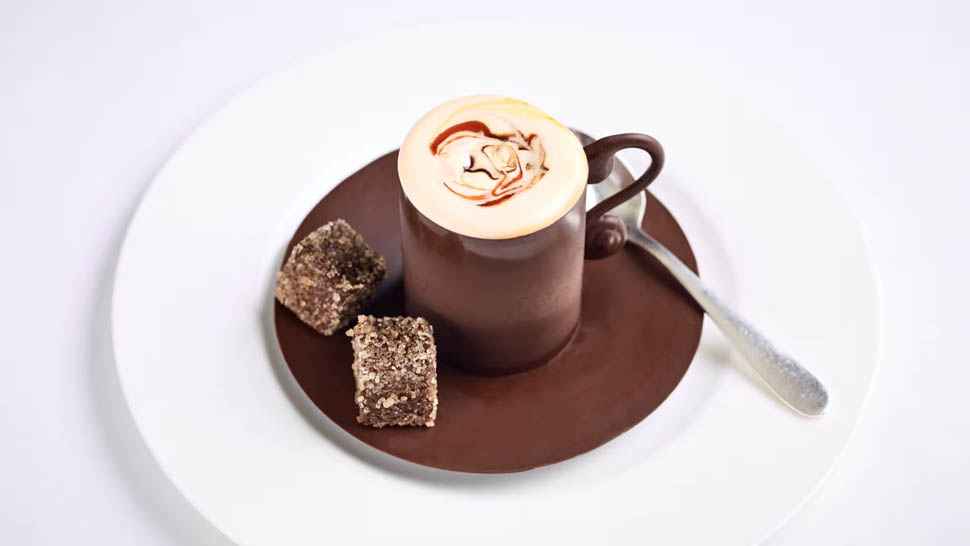
- Decorate with coffee extract or caramel.
- Arrange the ganache cubes and a teaspoon on the saucer.