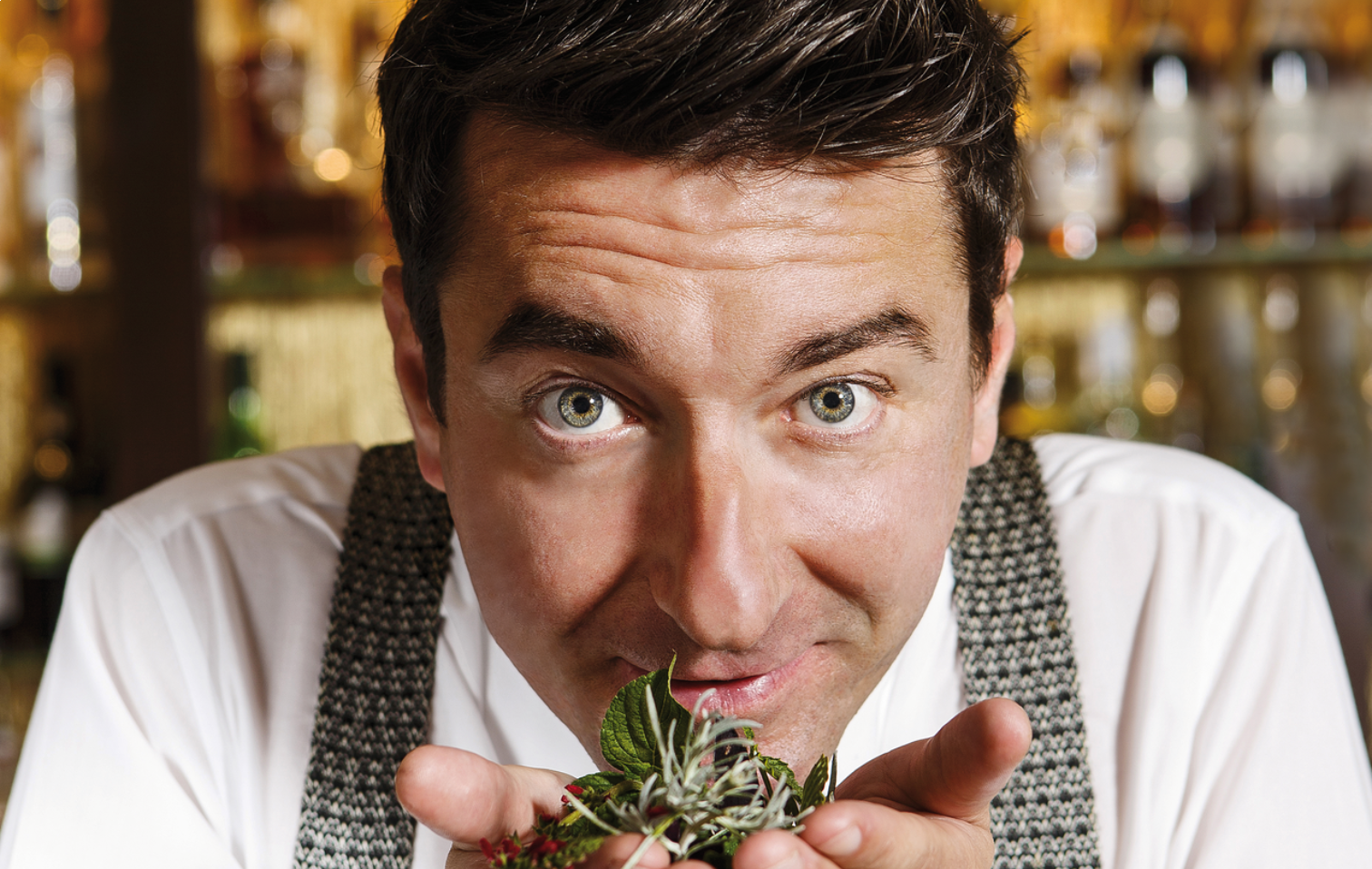
Bar director at the Majestic in Cannes, Balestra brings rigorous botany to mixology: aromatic gardens, rooftop hives, and “edible perfumes” developed with Robertet in Grasse. Gentle techniques—ultrasonic maceration and low-pressure distillation—make nose and palate converse across kitchen and bar.
Lombardy-born, he grew up close to greenery and landscapes—an inclination that became method: the scissors in the garden, the lab bench, then the bar counter. Smell is his lexicon: “aroma leads taste,” he says, describing how each cocktail starts from the scent of fresh plants, processed through precise extractions. In Cannes, at the Majestic, he has built an ecosystem of herbs, flowers, floral ice, syrups, and rooftop hives whose pollination sustains the hotel’s two aromatic gardens.
His path began early and abroad: at 19 he left Italy for Club Med in Opio and Val d’Isère; then Belgium (where a curiosity for wine took root) and Scotland, his first training ground for whisky. In 2008 he moved to Chicago as bar director at the Trump Tower, experimenting with textures and service-driven preparations. From 2009 he joined the reopening of La Mamounia in Marrakech, where daily contact with gardens broadened his botanical repertoire. He finally settled in Cannes in 2014, putting down roots on the Côte d’Azur.
His hallmark is the idea of “edible perfume” applied to drinks, dishes, and desserts: not a simple use of extracts, but a sensory syntax joining aesthetics, technique, and nature. The process—ultrasonic maceration followed by low-pressure distillation—yields clean, stable aromatic molecules for culinary use. Along this path Balestra collaborates with Maison Robertet in Grasse, a global reference for natural perfumery, weaving in know-how and quality controls from the aroma supply chain.
The Majestic’s lab and rooftop gardens are his daily observatory: verbena, sage, rose geranium, and lemon balm become jellies, bitters, ice, and signature vapors; the final gesture is often a mist that frames the sip with a coherent olfactory trail. The approach—spanning horticulture, beekeeping, and glass—invites chefs and bartenders to design experiences where the nose anticipates, accompanies, and extends flavor.
The outcome is a platform of gastronomic applications that draws on the Grasse supply chain and returns to the bar (and the pass) a vocabulary of edible perfumes: an invitation to calibrate aroma as an ingredient, from glassware conception to the closing gesture, with a discipline designed for professionals of taste.